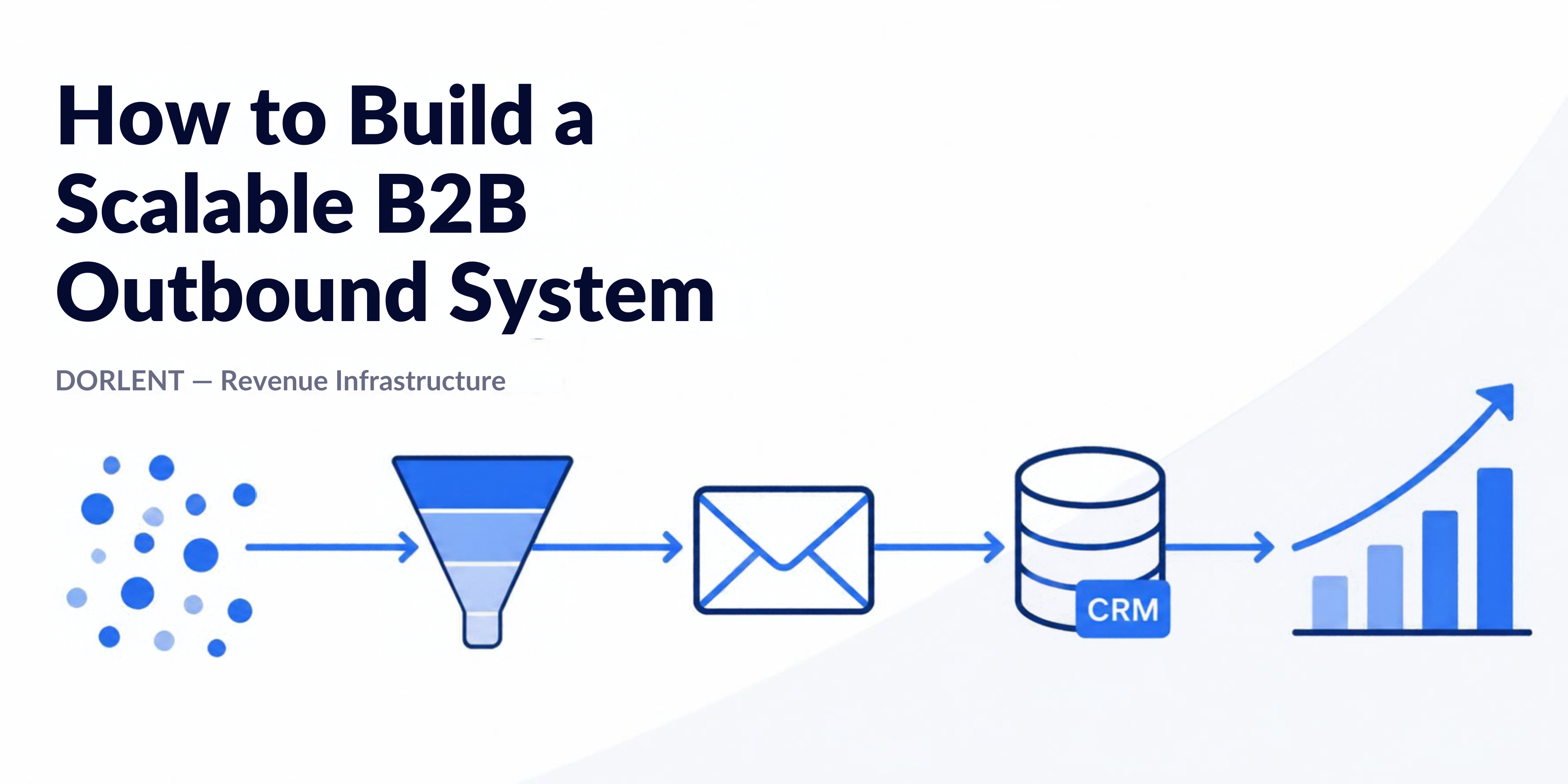
Most companies don't have an outbound problem.
They have an outbound system problem.
It's easy to start outbound today. Buy a list, connect a few mailboxes, write a sequence, and start sending.
Scaling it is much harder.
As volume increases, problems start appearing:
A scalable outbound system solves these problems by connecting targeting, data, enrichment, signals, personalization, outreach, CRM, and revenue measurement into one process.
For modern B2B teams, tools like Clay, Instantly, Smartlead, and HubSpot can provide the infrastructure to build that system.
But the tools aren't the system.
The architecture is.
What Is a Scalable Outbound System?
A scalable outbound system is a repeatable process for identifying the right companies and people, understanding why they may be a good fit, reaching them with relevant messaging, and turning conversations into measurable sales pipeline.
A simple outbound process looks like:
Target Market → Prospects → Email → Replies
A scalable system looks more like:
ICP → Accounts → Contacts → Enrichment → Signals → Qualification → Personalization → Outreach → Replies → CRM → Pipeline → Revenue
The difference is important.
A campaign can generate activity.
A system creates a repeatable process that can be measured, optimized, and scaled.
The 7 Layers of a Scalable Outbound System
A reliable outbound infrastructure typically has seven connected layers:
ICP and targeting
Prospecting and data
Enrichment and signals
Qualification
Personalization
Outreach and deliverability
CRM and revenue measurement
Each layer affects the next.
If your ICP is wrong, better copy won't fix the campaign.
If your data is inaccurate, personalization won't matter.
If your sending infrastructure is poor, your emails won't reach prospects.
And if outbound isn't connected to your CRM, you'll struggle to understand what is actually generating pipeline.
1. Start With the ICP, Not the Tools
The first step isn't opening Clay or setting up Instantly.
It's defining exactly who you want to reach.
Your Ideal Customer Profile should answer:
What industries do we serve?
What company size fits?
Which geographies matter?
Which business models are relevant?
Which roles are involved in the buying decision?
What problems do they have?
What events or signals indicate they may need our solution?
For example:
B2B SaaS companies
20–200 employees
North America
Sales-led organizations
Growing sales teams
VP Sales / CRO / Founder / RevOps
That's much more useful than:
"B2B companies in North America."
A scalable outbound system needs enough definition to consistently identify a good account, not simply an available contact.
2. Build a Reliable Data Layer
Once the ICP is clear, build your account and contact database.
This is where many outbound programs start breaking down.
Teams often collect thousands of contacts and try to figure out who matters later.
A better process is:
Find → Filter → Enrich → Qualify → Contact
Start with companies that fit your ICP.
Then identify the people who matter within those accounts.
Typical data points include:
The objective isn't to build the largest database.
It's to build a reliable database that can support repeatable outbound.
3. Use Clay as the Intelligence Layer
This is where Clay fits into the architecture.
Clay can sit between your prospecting sources, enrichment providers, AI research, CRM, and outbound tools.
Think of Clay as the GTM data and intelligence layer.
A typical workflow might look like:
Prospecting → Clay → Enrichment → Signals → Qualification → AI Research → Personalization → Outbound
Clay can help enrich companies and contacts with additional information and combine data from multiple providers.
More importantly, it can help build workflows around signals.
For example:
A company recently raised funding
The company is hiring salespeople
A new VP Sales joined
The company is expanding into a new market
A new product was launched
The company changed technology
The sales team is growing
This changes the targeting model from:
"Find companies that could need our service."
to:
"Find companies that fit our ICP and have a reason to care now."
That's a much stronger foundation for scalable outbound.
4. Qualify Before You Personalize
Not every prospect deserves the same amount of research.
A scalable system should prioritize prospects before spending time or credits on deeper enrichment and personalization.
One simple framework is:
Fit × Signal × Persona
Tier 1 — High fit + strong signal
Use deeper research and high-touch personalization.
Tier 2 — High fit + moderate signal
Use structured or semi-personalized messaging.
Tier 3 — ICP fit + weak signal
Use lower-touch outbound.
This approach makes the system more efficient.
Instead of spending the same amount of resources on every prospect, you allocate more effort to the prospects most likely to matter.
5. Personalization Should Create Relevance
Personalization is one of the most misunderstood parts of outbound.
Adding:
"I saw you're the VP of Sales at {{company}}."
isn't meaningful personalization.
Useful personalization explains why you're reaching out.
For example:
"Noticed you're hiring several enterprise AEs while expanding into the US."
That observation gives the prospect context for the conversation.
The goal isn't to prove that you've researched them.
The goal is to identify something relevant enough to make the outreach worth responding to.
Clay can help automate this research and generate structured personalization at scale.
But the system should still have clear rules around what counts as useful personalization.
Scalable personalization isn't about adding more information.
It's about consistently finding the right information.
6. Use Instantly or Smartlead for Outreach Execution
Once your data and messaging are ready, you need an outbound execution layer.
This is where Instantly and Smartlead fit.
They solve a different problem from Clay.
Think of the stack like this:
Tool & Role
Clay: Data, enrichment, research & GTM intelligence
Instantly: Email sending & campaign execution
Smartlead: Email sending & campaign execution
HubSpot: CRM, sales process & revenue tracking
Clay prepares and enriches the prospect.
Instantly or Smartlead executes the outreach.
HubSpot manages what happens after the prospect enters the sales process.
Keeping these responsibilities separate makes the overall system easier to manage and scale.
7. Design Email Infrastructure Before Scaling
Scaling outbound isn't simply increasing the number of emails you send.
Your email infrastructure needs to scale with it.
Before increasing volume, establish:
Sending domains
Mailboxes
SPF
DKIM
DMARC
Warmup
Sending limits
Bounce monitoring
Reputation monitoring
Don't treat deliverability as something you fix after a campaign starts failing.
It should be part of the system design from the beginning.
The objective isn't:
"How many emails can we send?"
It's:
"How much qualified outbound can we run while maintaining healthy sending infrastructure?"
8. Build Sequences Around Conversations
A scalable outbound system shouldn't rely on one email.
It should have a structured sequence that gives the prospect multiple opportunities to respond.
A simple sequence could include:
Email 1 — Relevant observation
Introduce the problem or signal.
Follow-up 1 — Simple question
Make it easy for the prospect to respond.
Follow-up 2 — New angle
Introduce another relevant business problem.
Follow-up 3 — Proof
Share a relevant result, example, or observation.
Follow-up 4 — Close the loop
Give the prospect an easy way to respond.
The objective isn't to send as many follow-ups as possible.
It's to create a repeatable conversation-starting process.
9. Connect Outbound to HubSpot
Outbound shouldn't exist separately from your CRM.
When someone responds positively, the next step should become part of your sales process.
For a HubSpot-based system, this could look like:
Positive Reply → Contact → Company → Lead Status → Owner → Follow-up → Meeting → Opportunity → Pipeline
Now your sales team can see:
Where the prospect came from
Which campaign generated the conversation
Who owns the lead
What stage they're in
What happened after the initial outreach
This is where outbound starts becoming part of your revenue infrastructure.
10. Measure Pipeline, Not Just Email Metrics
Outbound teams often focus on:
Emails sent
Open rates
Reply rates
Click rates
These metrics can help diagnose campaign performance, but they aren't the final goal.
A stronger measurement framework is:
Delivery → Replies → Qualified Replies → Meetings → Opportunities → Pipeline → Revenue
This allows you to answer much more important questions:
Which ICP segments perform best?
Which personas respond?
Which signals create conversations?
Which messaging angles work?
Which campaigns generate opportunities?
Which segments generate revenue?
The ultimate question isn't:
"Which campaign got the most replies?"
It's:
"Which outbound activity is generating qualified pipeline?"
11. Build a Feedback Loop
A scalable outbound system shouldn't remain static.
The results from sales should continuously improve the system.
For example, imagine you target three segments:
SaaS companies
IT services companies
Professional services companies
After running campaigns, you may find that one segment consistently produces more qualified conversations and opportunities.
That information should influence your next campaigns.
The same applies to:
Personas
Signals
Messaging
Offers
Data sources
Personalization
Campaign structure
The system becomes:
Target → Enrich → Contact → Learn → Optimize → Repeat
This feedback loop is what allows outbound to improve as volume increases.
The Scalable Outbound Architecture
A modern outbound system can be represented like this:
                    ICP
↓
Account Selection
↓
Clay
┌──────────┼──────────┐
↓          ↓          ↓
Enrichment    Signals    Research
└──────────┼──────────┘
↓
Qualification
↓
Personalization
↓
┌──────────┴──────────┐
↓                     ↓
Instantly             Smartlead
└──────────┬──────────┘
↓
Replies
↓
HubSpot
↓
Sales Pipeline
↓
Revenue
↓
Feedback
↓
Clay
The final feedback loop is critical.
Your outbound system should learn from what happens after the email is sent.
If a particular segment generates meetings but another doesn't, your targeting should change.
If a certain signal produces high-quality opportunities, prioritize similar accounts.
If a message generates replies but no qualified opportunities, reconsider the offer or targeting.
Scaling isn't simply doing more of the same.
It's improving the system as volume increases.
Common Mistakes When Scaling Outbound
Starting With Tools
Buying Clay, Instantly, or Smartlead doesn't create an outbound strategy.
Define the system first.
Sending to Huge Lists
More contacts don't automatically mean more pipeline.
Data quality and relevance matter more than raw volume.
Confusing Enrichment With Personalization
Knowing someone's title isn't personalization.
You need a relevant reason to contact them.
Using One Message for Everyone
Different segments have different problems.
Your messaging should reflect the persona, segment, signal, and offer.
Ignoring Deliverability
Increasing volume without protecting your sending infrastructure can create problems that are difficult to recover from.
Measuring Only Replies
A reply isn't revenue.
Track the journey from:
Reply → Qualified → Meeting → Opportunity → Pipeline → Revenue
Keeping Outbound Separate From the CRM
If your outbound activity lives in one system and your sales pipeline lives somewhere else, you eventually lose visibility.
Outbound Is Revenue Infrastructure
A scalable outbound system isn't about sending more emails.
It's about building an infrastructure where every part of the process works together.
CRM → Data → Signals → Enrichment → AI → Outbound → Sales → Revenue
Clay can provide the intelligence and data orchestration layer.
Instantly or Smartlead can provide the outbound execution layer.
HubSpot can provide the CRM and revenue layer.
But the real advantage doesn't come from owning these tools.
It comes from connecting them into a system that consistently answers:
Who should we target?
Why now?
What should we say?
How should we reach them?
What happens when they respond?
Did the conversation create pipeline?
When those pieces work together, outbound stops being a collection of disconnected campaigns.
It becomes a scalable GTM system.
And that's what modern B2B teams need: not more tools, but a revenue infrastructure that can grow with them.